


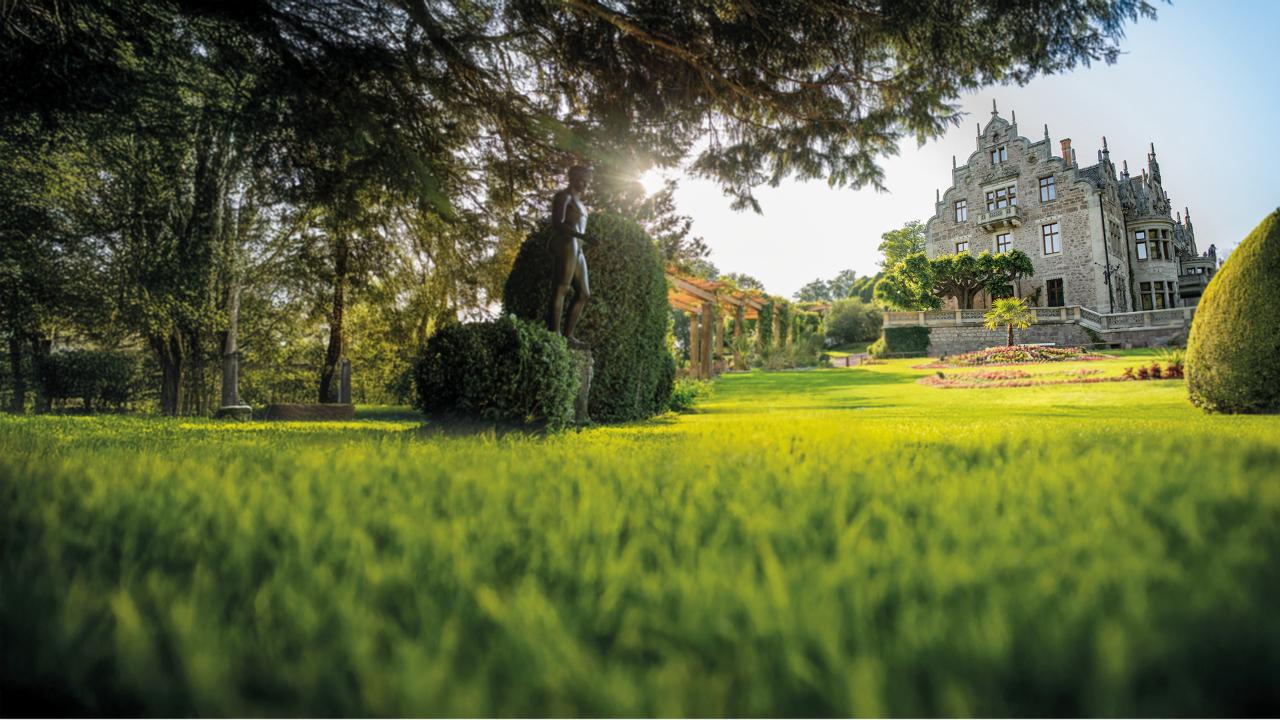
You're in the right place! Whether in nature, in the middle of the city, for families, in the countryside, historic or traditional: among Thuringia's TOP hosts, everyone will find exactly the right address.
Sheep, storks and slow food
Stiftsgut Wilhelmsglücksbrunn
Three stork nests, a llama and award-winning blue cheese - where can you find that? In idyllic Wilhelmsglücksbrunn in the far west of Thuringia.
The Stiftsgut Wilhelmsglücksbrunn is located very close to the border with Hesse. An organic hotel, slow food restaurant and Bioland-certified farm.
⠇

The Stiftsgut has now been renovated and it is hard to imagine that it was a ruin 25 years ago. In 1997, work began on converting the Stiftsgut, which was completely dilapidated at the time, into an organic farm. It has always been organised as an inclusive farm. The Karsten family has been involved since the beginning. Robust (and fluffy) Galloway cattle were purchased, as well as a herd of Lacaune sheep from the south of France, which are known for their good milk yield. Water buffalo populate the marshy areas around the farmstead and beat their long tails back and forth monotonously. Almost like in Asia.
Later, the company added its own organic cheese dairy, an organic shop and the restaurant and hotel business. Organic raw materials are used consistently everywhere.
We caught a wonderful summer's day to visit the Stiftsgut. Even on the short journey from the B7 to the estate, we can feel the sense of relaxation spreading through our car. To the right of the access road, we see the first Galloways standing around in the hilly landscape. Countless cyclists come towards us: Wilhelmsglücksbrunn lies directly on the Werratal cycle path. I immediately have a holiday feeling.
⠇

We relax in the beer garden by the pond together with numerous cyclists.
We are greeted on the farm not only by Mrs Karsten, but also by the clattering of a stork that lives on the roof of the main house. He is not the only one. Two other stork families have also chosen the estate as their home. At first glance, I am not surprised that they feel at home here. In front of the main house, the tables of a beer garden extend loosely to a terrace by the lake. In the courtyard, a well-stocked organic market awaits visitors on the right and the barn, which has been converted into holiday flats, is on the left. Hotel rooms are located in another building.
⠇

First we visit the cheese dairy. There, Philip Gräfenhahn is putting the finishing touches to his current production batch. He turns the fresh wheels of cheese with practised movements. "I make fresh cheese every two days. Today it's semi-hard cheese with fenugreek. I have to turn it once more and then it goes into the salt bath". Until then, Philip shows us the maturing chambers. The cheeses are stored here at different temperatures. The red smear cheese matures for 4 weeks, the semi-hard cheese for 6 - 8 weeks and the Creuzburger Pecorino matures for a full 12 - 16 months. The cheeses on offer include cream cheese, shepherd's cheese and hard cheese. They are all available in their own organic shop and, of course, in the restaurant.
When Philip is not making cheese, he makes ice cream from the sheep's milk. "It's great: the milk arrives fresh in the morning. The sheep are right over there. Then I pump the milk over and start making the cheese or ice cream. Depending on what's on the menu." Anyone who thinks that ice cream made from sheep's milk tastes harsh is mistaken. Instead, it is particularly creamy and smooth.

Cheese from the cheese dairy at Biohotel Stiftsgut Wilhelmsglücksbrunn, ©Florian Held, Thüringer Tourismus GmbH
"It's a lot about smelling, tasting and feeling," says Philip. "It's nothing like the job I had before at a large milk producer. Everything was automatic there."
Taste is our keyword. We head over to the organic shop to try the cheese we've been talking about so much. Whilst the pecorino is milder than expected, it has a particularly creamy flavour. Just like the semi-hard cheese. We are curious about the Creuzburger Blauen, which won an award at the Biocaseus competition in Italy. An aromatic blue cheese that simply melts in the mouth. Not a hint of sharpness, as is often the case with Gorgonzola, but simply a creamy delicacy that I wish I had on my next cheese platter. Interesting to know: the milk from Lacaune sheep is traditionally used in the production of Roquefort - so it's no wonder that the Creuzburger Blaue bears a certain resemblance.

Llama at the Biohotel Stiftsgut Wilhelmsglücksbrunn in Creuzburg, ©Mira Held, Thüringer Tourismus GmbH
Before we continue our tour of the estate, it's time to pay a visit to the sheep. All year round, they move between the open stable and the meadow. There they live together with a llama. Why? Because the llama protects the sheep from the threat of wolves. In the event of an attack, it fearlessly pounces on the wolf, makes warning noises, kicks and, of course, spits in an emergency. What has been common practice in America for decades to protect livestock herds against prairie dogs and cougars is rather unconventional in Germany. ‘That's the way organic farming works from time to time,’ explains Mrs Karsten with a shrug.
After our tour, we treat ourselves to a slice of the popular poppy seed cake, drink affogato with sheep's milk ice cream and a whey with yoghurt. The Stiftsgut employs a trained pastry chef who bakes traditional Thuringian sheet cakes. This not only goes down well with the many tourists who take a break from cycling in the beer garden, but also with us. I'm not particularly fond of poppy seeds or sultanas, but the cake is still delicious. The whey and sheep's milk affogato are also great.
⠇

Encouraged by this coffee experience, we take a long stroll around the estate and watch the water buffalo. In the golden evening light, we round off the evening in the beer garden by the pond. There is Rother-Bräu, a beer from a family-run brewery in the Rhön, and all kinds of specialities from the Stiftsgut.
We opt for water buffalo stew, baked sheep's cheese, lamb fillet and the CreuzBurger, whose patty is made from a mixture of Galloway beef and buffalo meat. Slow food as it is written in the book. We are amazed at how many dishes are based on our own produce or other ingredients from the region. All the food used in the restaurant is organically grown.
⠇

After Flo and I have eaten one last scoop of the delicious sheep's milk ice cream, we slowly make our way back to Erfurt. It's a shame we didn't rent a room in the hotel straight away.
⠇
Info in brief
The restaurant is open daily from 12pm - 10pm in summer. Reservations are required in winter. The organic market, which also sells fresh lamb, water buffalo and Galloway meat, is open from Wed - Sat 10am - 6pm. Stiftsgut Wilhelmsglücksbrunn has 7 holiday flats and 20 hotel rooms.
⠇

Our gourmet experts
Mira and Flo from the blog ‘How To Gourmet’ are two true Thuringians and gourmets through and through. We discover culinary beacons in Thuringia with them. Stories of pleasure wherever you look. They seek out new impressions and delicacies at every opportunity, which they present on their blog ‘How to Gourmet’.
Accessibility
Did you like this story?
nebenan, kulinarik, such-thema_kulinarik
Visitors' information
Upcoming events
Events
Offers
Restaurant tipp
TOP hosts nearby
You might also be interested in ...

Sustainable Thuringia
Sustainability is on everyone's lips, and it is important. It's about us and our future, about a healthy environment, healthy people, a fair and just world for everyone. Come along and discover good examples in Thuringia – certified spots, sustainabel offers, national natural landscapes and more!


